Friday, February 5, 2016

Smile


Charlie Chapman's movie "Modern Times" opened in New York on this day in 1936.  It was the last film with his character the Little Tramp, and the only film to include his voice.  From the Writer's Almanac:

When the movie opens, the Little Tramp is working in a factory, but his mindless and repetitive task - which he must perform faster and faster to satisfy the foreman - drives him mad and he literally becomes a cog in the great machine of industry. He spends the rest of the movie in a series of jobs, and tries to get arrested so he can have three meals a day and a place to sleep. 

Eventually, he finds happiness in an anarchist lifestyle with his co-star, Paulette Goddard, who plays the "Gamine." They walk off into the sunset to the strains of the song "Smile," which was composed by Chaplin.

Thursday, February 4, 2016

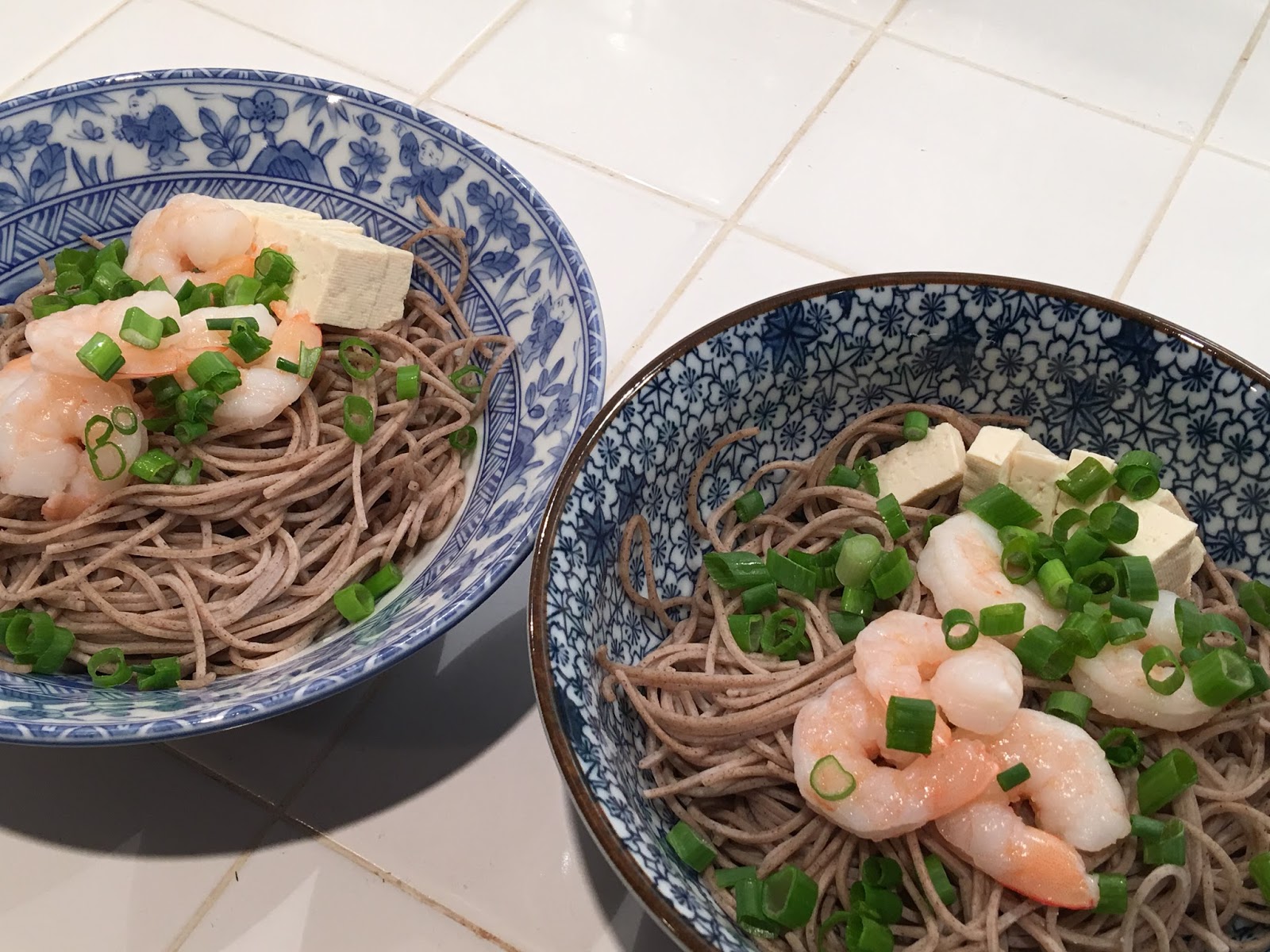
Homemade pho

Vietnamese pho and ramen soup shops are popular in Seattle.  It isn't too hard to assemble a bowl of Asian noodle soup at home using whatever vegetables you have on hand.  And if you plan ahead, you can make something really special and healthy for dinner.

Those brown noodles are called soba, made from buckwheat flour. They are served a variety of ways in Japan but especially popular as inexpensive fast food, sold on the street and in railway stations.  Soba noodles are either served chilled with a dipping sauce, or hot in soups.  Soba noodles do not contain wheat.

For the last month I've been trying to eliminate (or at least limit) high glycemic foods from my diet. That includes refined grains like white bread and pasta, white rice and potatoes, and of course, sugar.  This sounds depressing, especially if you are John and believe pasta is required to sustain life.

Frankly, I soon lost my taste for sweets and bland starches.  It also helps that my genetic food cravings tend to be along the lines of bacon and sausage, not pie and cake.  Anyway, I feel much better on a diet heavy on vegetables, and there are some things I'm not willing to give up, like coffee and wine. So life is still good.

Anyway, on to Asian noodle soup. Unless you do it from scratch (I don't) the soup is made with a bottled, highly condensed sauce.  On the back of the bottle you will find some cryptic and confusing instructions on how to dilute it. Ignore them.

After I saute some minced ginger and garlic, I add a can or two of chicken or vegetable broth, then add the soup base "to taste."  The amount I used from that soy sauce sized bottle was enough to flavor a good sized pot.  So a little goes a long way.

After the broth simmered, I added some fresh bok choy right before serving so it stayed fairly crisp.    

The boiling broth is ladled over the room temperature noodles and whatever cooked protein, in this case a bit of shrimp and tofu. I had some fresh cilantro to top it off, but basil would be just as good.  It didn't take us long to slurp up two big bowls of the stuff last night.


Wednesday, February 3, 2016

Slow but sure


Aspect of the Month- 

Slow but sure is the progress Nature is making; first a bud or two of larger size than usual appear, then we discover another already silvered over with its greenish grey, and after a shower and a day of sunshine, it is wonderful to witness the bulk some of the more favorably situated blossoms have attained. 

Page from a 19th century nature book,
courtesy of the blog Old Books and Things.


By the way, this magnolia tree once stood near the entrance of the the old Museum of History and Industry on the shore of Lake Washington.   I took these pictures in February 2012.

The museum building was demolished last year to make way for the 520 floating bridge expansion project.  The museum library was relocated to a resource center (i.e. warehouse) in Georgetown, an industrial part of south Seattle.

My archive projects are as interesting as ever, but of course the ambiance of "going to work" has changed.  Although I drive by Costco on the way home, which is convenient for picking up a $5 rotisserie chicken for dinner.


The clock tower is now outside the popular new museum on Lake Union.  I heard from one of the librarians that Plant Amnesty rescued some of the mature plants before demolition, and hopefully that was the case with this lovely bird nest tree.

Progress, Seattle style

Tuesday, February 2, 2016

Candlemas Day


When the Germans arrived in America in the 1700's, they brought along the traditions of Candlemas Day. February 2 falls at the mid-point between the winter solstice and the spring equinox.

If the weather was fair, it was believed the second half of the winter would be stormy and cold. This weather lore originated with the pagan celebration of Imbolc.

Candlemas Day marks an early episode in the life of Jesus: The Presentation at the Temple.  The clergy would bless candles and distribute them in the dark of winter.  People would put lighted candles in their windows to mark the return of warmth and light. 


If Candlemas be fair and bright,
Come, winter, have another flight,
If Candlemas brings clouds and rain,
Go winter, and come not again.

Old English song

This morning "Phil" did not see his shadow. Since his first prediction in 1887, he has not seen it on only 18 occasions. With the usual hoopla, the Ground Hog Club proclaimed, "There is no shadow to be cast! An early spring is my forecast!"

Monday, February 1, 2016

Warm fire on a chilly day


Welcome February!  Tomorrow we find out what the groundhog has to say about Spring.

Yes, you've seen this picture on the blog before. It's my favorite calendar page from the Book of Hours, the most famous example of French Gothic illuminated manuscript illustration still in existence. It is probably the most valuable book in the world.

The book was created for Jean de France, Duc de Berry, the richest man of his time, described as extravagant, greedy and ruthless. He was a bon vivant, fond of food and sensual pleasures. He traveled between his magnificent castles and estates living the good life.  He was also a passionate book collector, and a patron of artists.

Duc de Berry

In 1409, he hired the Limbourg Brothers, famous Dutch miniature painters, to illuminate a personal Book of Hours prayer book.  He was pleased with their work, and the brothers received favors and court positions.

In 1416, the three Limbourg brothers died, presumably of the plague. They were under 30 years old, which seems unbelievable, considering their accomplishments. The Très Riches Heures was still unfinished, but other artists completed the book later.  The February illustration, however, is attributed to the Limbourg brothers.

As they say, every picture tells a story. You can get lost in the detail of medieval farm life under the cold winter light, men working, the sheep, dove cote and beehives.

OK, maybe the naughty details are the most interesting.  A cut-away view of the house interior shows two peasants immodestly keeping themselves warm, while the fine lady in the beautiful blue dress looks the other way. 

Friday, January 29, 2016

The soup month

Beef Barley

Everybody Made Soups
Poem by Lisa Coffman


After it all, the events of the holidays,
the dinner tables passing like great ships,
everybody made soups for a while.
Cooked and cooked until the broth kept
the story of the onion, the weeping meat.
It was over, the year was spent, the new one
had yet to make its demands on us,
each day lay in the dark like a folded letter.
Then out of it all we made one final thing
out of the bounty that had not always filled us,
out of the ruined cathedral carcass of the turkey,
the limp celery chopped back into plenty,
the fish head, the spine. Out of the rejected,
the passed over, never the object of love.
It was as if all the pageantry had been for this:
the quiet after, the simmered light,
the soothing shapes our mouths made as we tasted.